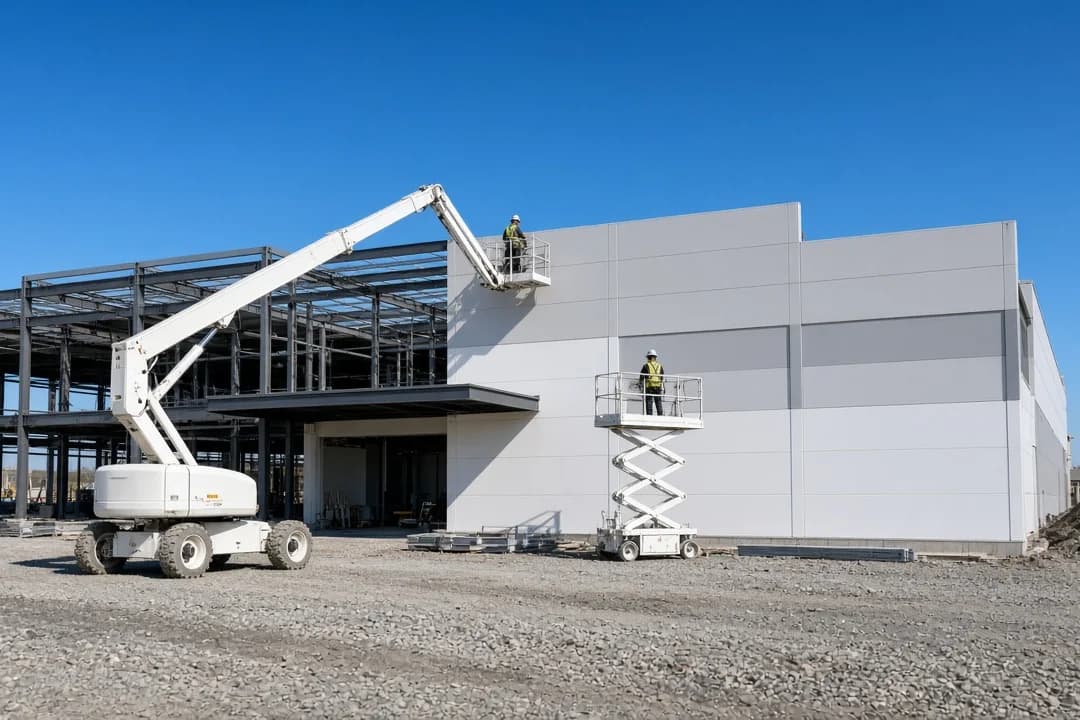
Three Types of Lift
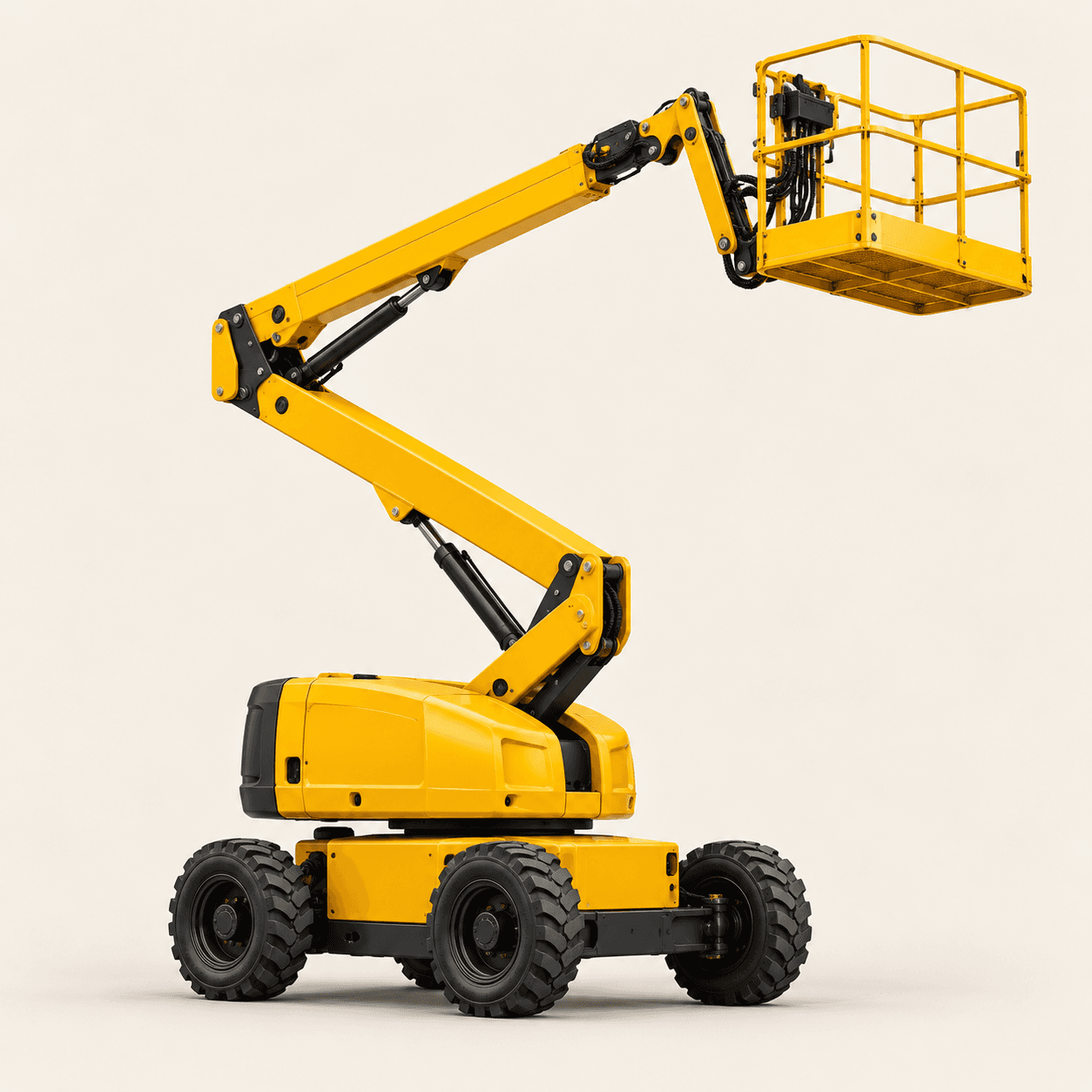
An articulating boom, sometimes called a knuckle boom, has an arm that bends at one or more joints. That lets the platform rise, reach out and come back down over an obstacle such as a canopy, a parapet or a run of rooftop equipment. Genie lists this as up-and-over clearance; on its Z-45 XC it's 24 ft 5 in.
A telescopic boom, or straight boom, extends in a straight line. It trades some of that flexibility for more height and much more horizontal outreach from one setup: Genie's S-85 XC reaches 74 ft 6 in out at its maximum, and it can also reach 8 ft 8 in below the level the machine sits on.
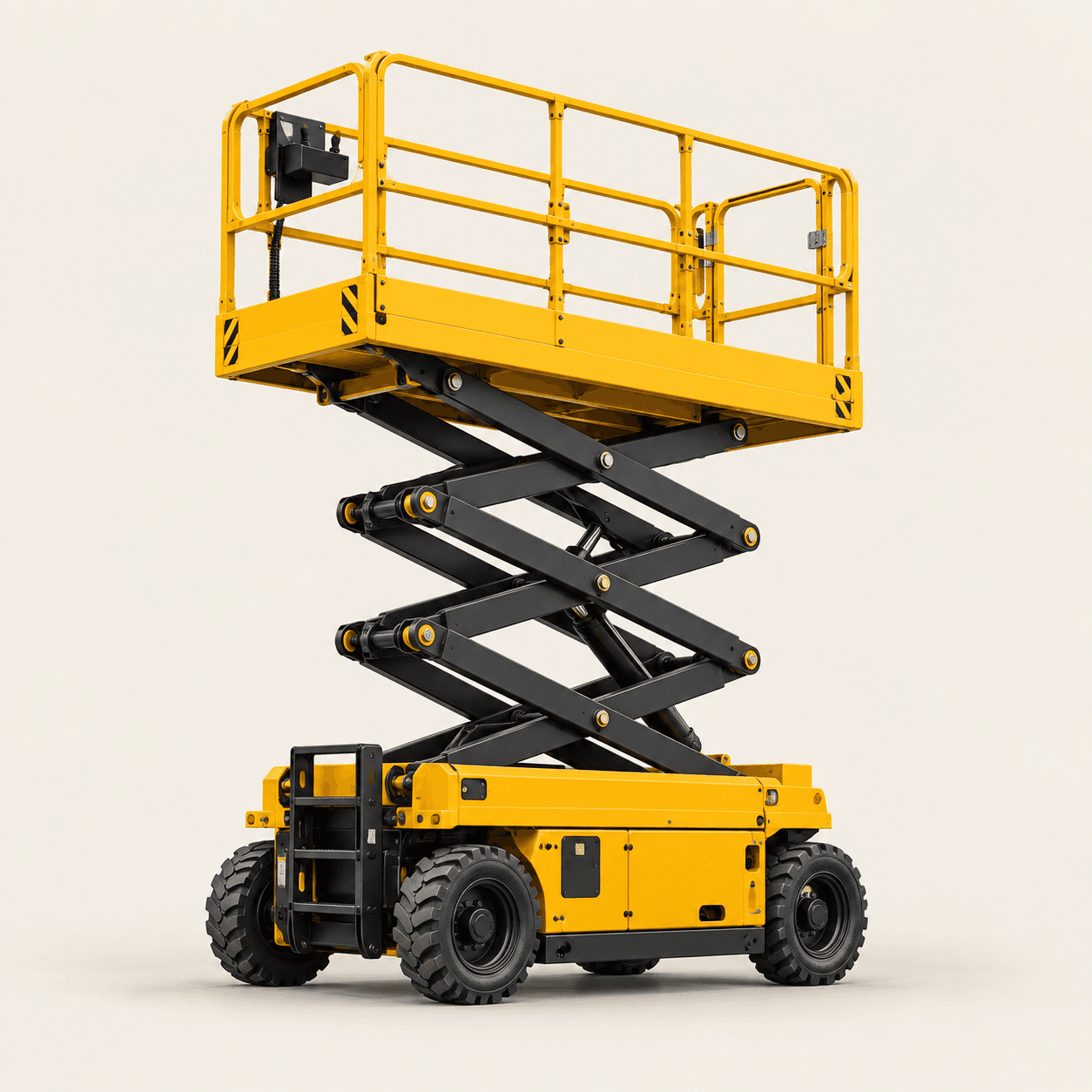
A scissor lift raises a wide platform straight up on crossed supports. It has little or no outreach, but its deck holds a worker alongside materials, and it's often the simplest machine for ceiling and wall work above a level floor. OSHA classifies scissor lifts differently from booms, as the safety section explains.
What Each Type Is Best For
Best for: Articulating boom
- Reaching up and over canopies, parapets, piping and other obstacles
- Working around building features in tight areas
- Zero-tailswing models beside walls, traffic or other trades
- Narrow electric models for indoor work and finished floors
- Facades, lighting, signs and roof edges at low to mid heights
Best for: Telescopic boom
- Maximum height and straight-line outreach from one setup
- Reaching across landscaping, trenches or setbacks to a building face
- Tall walls, steel and glazing on large commercial and industrial buildings
- Covering a long elevation with fewer moves
- Some models reach below grade, such as over an excavation edge
Best for: Scissor lift
- Ceilings, lighting, sprinklers, HVAC and drywall directly overhead
- Work that needs room for a worker plus materials on the deck
- Level slabs and finished floors, with electric slab models
- Long runs along a wall or ceiling, driving between tasks
- Rough-terrain models for outdoor work on firm, graded ground
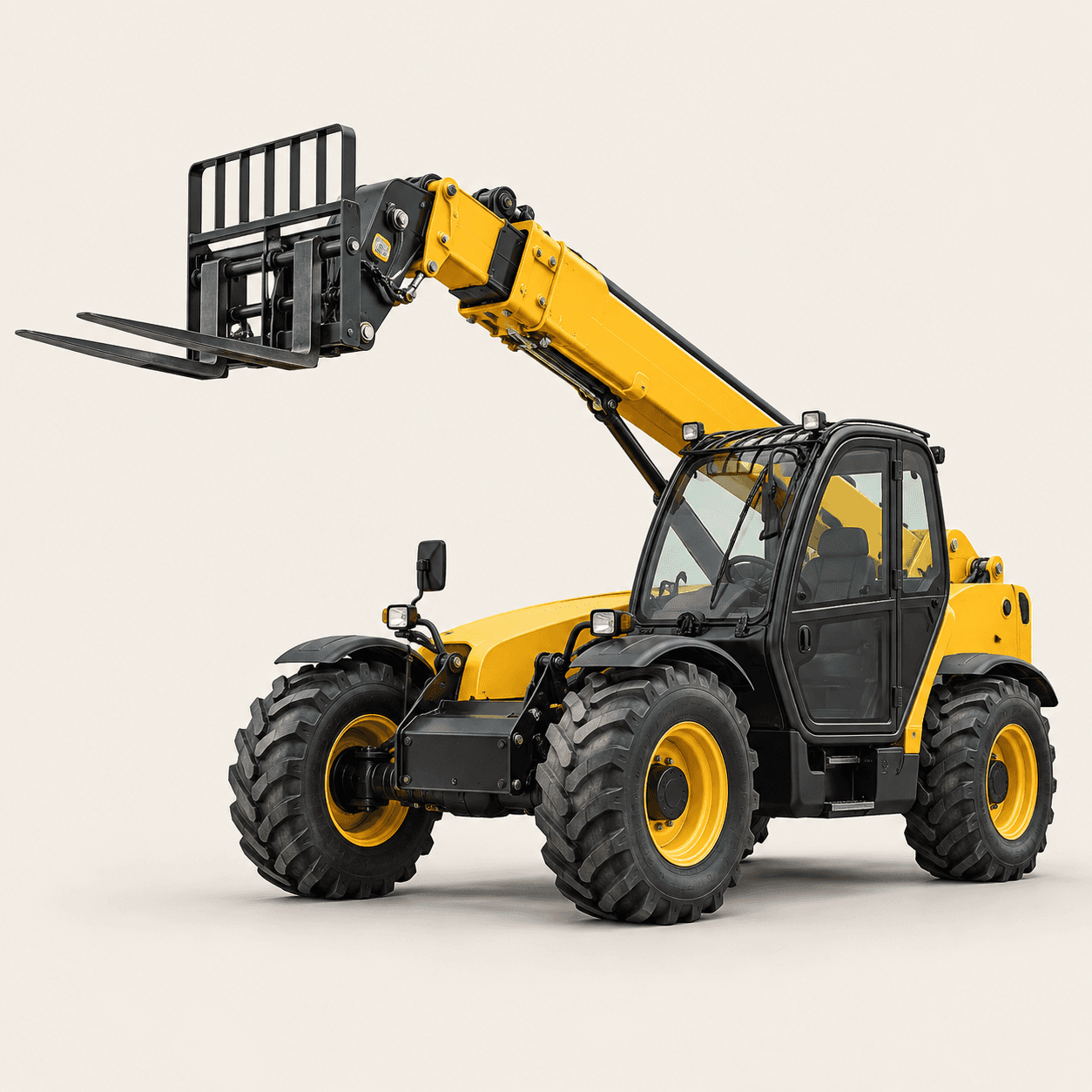
Aerial lifts are built to carry workers and their tools. To lift and place pallets, bundles or roofing, a telehandler is the machine designed for the job. For configurations and sizes, see the boom lift and scissor lift pages.
Working Height, Platform Height and Reach
Manufacturers publish two heights. Platform height is how high the floor of the platform goes; working height adds an allowance for a person standing on it. Genie's US spec sheets add 6 feet to platform height, so its Z-45 XC lists 45 ft 6 in of platform height and 51 ft 6 in of working height.
Measure to the actual work point, then measure the horizontal distance from the closest spot the machine can safely sit. A boom's maximum height and maximum outreach aren't available at the same time, so check the manufacturer's range-of-motion chart, which shows where the platform can reach at each height, rather than the headline numbers.
The specs below are illustrative, not a ranking; confirm the exact machine with your provider.
| Model | Type | Platform height | Horizontal reach | Platform capacity | Width | Weight |
|---|---|---|---|---|---|---|
| Genie Z-30/20N (electric) | Articulating, narrow | 30 ft | 21 ft 5 in | 500 lb | 3 ft 11 in | 14,183 lb |
| Genie Z-45 XC (diesel) | Articulating | 45 ft 6 in | 24 ft 9 in | 660 lb unrestricted; 1,000 lb restricted | 7 ft 6 in | 16,360 lb |
| JLG 600S | Telescopic | 59 ft 8 in | 50 ft 2 in | 600 lb unrestricted; 1,000 lb restricted | 8 ft 2 in | 21,647 lb |
| Genie S-85 XC (electric) | Telescopic | 85 ft | 74 ft 6 in | 660 lb unrestricted; 1,000 lb restricted | 8 ft 2 in | 38,908 lb |
| Model | Platform height, indoor | Platform height, outdoor | Capacity | Width | Weight |
|---|---|---|---|---|---|
| Genie GS-1930 | 19 ft 3 in | 14 ft 8 in | 500 lb | 2 ft 6.2 in | 3,209 lb |
| Genie GS-3246 | 32 ft 1 in | 22 ft | 700 lb | 3 ft 10 in | 5,218 lb |
Note the scissor rows: Genie rates these slab scissors for less height outdoors than indoors. If a scissor will work outside, check the outdoor rating, not the bigger indoor number.
Sources
Platform Capacity
Platform capacity is the total weight of people, tools and materials the platform is rated to carry, so add it up before you book.
Many booms publish two ratings. Genie's Z-45 XC and S-85 XC carry 660 lb anywhere in their working range and up to 1,000 lb in a restricted zone closer to the machine, and JLG lists 600 lb and 1,000 lb for the 600S. If the job needs the higher rating, confirm on the range chart that the work point sits inside that zone. Narrow electric booms are rated lower; the Z-30/20N carries 500 lb.
OSHA prohibits exceeding the boom and basket load limits specified by the manufacturer.
Weight, Ground and Access
In the table above, booms run from about 14,000 lb for a narrow 30-foot electric model to nearly 39,000 lb for an 85-foot telescopic, and that weight has to rest on whatever is under the tires.
Manufacturers publish pressure figures to help. Genie lists the Z-45 XC at 80 psi tire contact pressure and 231 psf occupied floor pressure, and the S-85 XC at 198 psi tire contact pressure; JLG lists a maximum ground bearing pressure of 83 psi for the 600S. Compare those numbers with the slab, deck or soil you'll drive on, and get an engineer's answer before driving onto a suspended slab, a parking deck or fresh backfill.
Check width and tailswing for access. The Z-30/20N is 3 ft 11 in wide with zero tailswing, so it fits openings the 7 ft 6 in Z-45 XC can't. Telescopic booms swing wider: JLG lists 4 ft of tailswing on the 600S and Genie 5 ft 9 in on the S-85 XC, so mark off the swing area from traffic and other trades.
Slope matters too. Genie lists tilt sensor activation at 4.5 degrees for the Z-45 XC, and JLG a 5-degree tilt cutout for the 600S. North Texas clay, which USDA describes as very sticky and very plastic when wet, can turn a firm pad soft after rain, so plan mats or wait for the ground to dry before driving a loaded boom across it.
Power Lines
Overhead lines are one of the most serious hazards for any lift. Texas Health and Safety Code chapter 752 covers lines carrying more than 600 volts, and unless the danger is guarded against as the chapter prescribes, it bars anyone from bringing any part of a tool, machine or equipment within 6 feet of such a line.
Getting closer starts with notice. Whoever is responsible for the work must notify the line's operator at least 48 hours before it begins and can't start until both sides agree on temporary de-energizing and grounding, relocating or raising the line, or mechanical barriers. The person or business responsible for the work pays the operator's actual cost.
OSHA Rules and Safe Use
- Boom lifts are aerial lifts under OSHA 29 CFR 1926.453. Lift controls must be tested each day before use, and only authorized persons may operate the lift.
- Workers must stand firmly on the floor of the basket, and may not sit or climb on the edge or use planks, ladders or other devices to gain a working position.
- A lanyard must be attached to the boom or basket, and belting off to an adjacent pole, structure or equipment isn't allowed.
- Brakes must be set and outriggers, when used, positioned on pads or a solid surface; wheel chocks go in place before using a lift on an incline.
- Scissor lifts are treated differently. In a 2000 interpretation letter, OSHA said scissor lifts aren't aerial lifts but mobile scaffolds covered by its scaffold standards, and that properly maintained guardrails provide the fall protection, so tie-off isn't required by that standard.
- Everyone working from a scaffold, including a scissor lift, must be trained by a qualified person in its hazards, including electrical hazards, fall hazards and the platform's load capacity.
Weather sets limits as well. Check the operator's manual for the machine's rated wind speed and bring the platform down for storms; the National Weather Service in Fort Worth notes that thunderstorms and severe weather peak in spring. This summary doesn't replace the regulations, the manufacturer's manual or your site's safety plan.
Choosing a Lift for DFW Work
The building stock decides a lot. Grand Prairie says new warehouse, distribution and manufacturing buildings continue to go up in and around the Great Southwest Industrial District, work that calls for telescopic booms on tall walls and roof edges and scissor lifts inside.
In older, built-out cities, renovation is the norm. Richardson encourages reuse, reinvestment and activation of existing buildings in its Collins/Arapaho Innovation District, and Garland's strategic plan describes a largely built-out city reinvesting in aging commercial corridors. Both point to electric scissors and narrow booms inside occupied buildings, as do renovations of open retail and office buildings in Arlington. On Carrollton's transit-oriented sites, buildings sit close to the sidewalk, which favors articulating booms that can work up and over from a narrow strip.
Local rules shape the schedule. Richardson limits lane closures to 9 a.m. to 3:30 p.m., and Carrollton's noise ordinance limits construction equipment within 1,000 feet of a residence to set hours. Irving borders DFW Airport and Grand Prairie has a municipal airport, and near runways federal rules can require FAA notice for tall equipment, including temporary cranes. Each city page has the details and sources.
Sources
- City of Grand Prairie: About Grand Prairie
- City of Richardson Enhancement Areas
- City of Garland, Garland on the Rise Strategic Plan 2026–2036
- City of Carrollton Transit Center (TC) Zoning District
- City of Richardson Right-of-Way Permits
- City of Carrollton Code sec. 130.18, Unlawful noise
- 14 CFR 77.9, construction or alteration requiring FAA notice
Specifications are taken from manufacturers' published materials and can change. This guide is general information. Always follow the manufacturer's instructions, your rental provider's requirements and your jobsite's safety rules.