When a Protective System Is Required
OSHA requires each employee in an excavation to be protected from cave-ins by an adequate protective system, except when the excavation is made entirely in stable rock, or is less than 5 feet deep and a competent person examines the ground and finds no indication of a potential cave-in.
Depth changes who designs the system. OSHA's trenching fact sheet notes that trenches 20 feet deep or greater require a protective system designed by a registered professional engineer or based on tabulated data prepared or approved by one.
Cities often go further on public work. Frisco requires a trench safety plan before the pre-construction meeting for storm, water and wastewater work; McKinney requires a City-accepted plan on site for right-of-way excavations deeper than 5 feet; and Grapevine requires plans prepared by a licensed professional engineer for trenches deeper than 5 feet.
Sources
- OSHA 29 CFR 1926.652 (protective systems)
- OSHA trenching and excavation safety fact sheet
- City of Frisco Engineering Standards, General Notes (October 2025)
- City of McKinney Right-of-Way Construction and Permitting Procedures Manual (effective July 1, 2025)
- City of Grapevine Construction Standard Details, General Notes (PDF)
Soil Types: Stable Rock, Type A, B and C
Sloping and benching, and most tabulated shoring data, depend on soil classification. A competent person classifies each deposit using at least one visual and one manual test, and reclassifies it if conditions change.
Best for: Type A
- Cohesive soil with unconfined compressive strength of 1.5 tons per square foot or more
- Not Type A if fissured, subject to vibration from heavy traffic or pile driving, or previously disturbed
Best for: Type B
- Cohesive soil between 0.5 and 1.5 tsf
- Previously disturbed soils, and Type A-strength soil that is fissured or subject to vibration
Best for: Type C
- Cohesive soil at 0.5 tsf or less, and granular soils such as gravel and sand
- Submerged soil or soil with water freely seeping
Rain changes the answer. OSHA's appendix says that if an excavation is later exposed to wetting, the classification must be changed accordingly. Blackland Prairie clays common across DFW are described by USDA as very high in shrink-swell, and NWS Fort Worth notes spring and fall are the wettest seasons, so a trench classified on a dry morning may need reclassifying after a storm. Old utility trenches and backfilled lots are previously disturbed soil, which can't be Type A.
Sloping and Benching
| Soil | Maximum slope (H:V) | Notes |
|---|---|---|
| Stable rock | Vertical | Must remain intact while exposed |
| Type A | 3/4:1 | 1/2:1 allowed for short-term excavations 12 ft deep or less, open 24 hours or less |
| Type B | 1:1 | Vertically sided lower portions must be shielded or supported |
| Type C | 1-1/2:1 | Vertically sided lower portions must be shielded or supported |
Sloping takes room. A 10-foot-deep cut in Type C soil at 1-1/2:1 reaches back 15 feet on each side, which is often more than a residential lot or street right-of-way can give. That is when shoring or a trench box becomes the practical choice, and it affects what size excavator can reach and where spoil can go. See what size excavator do I need for reach and dig depth.
Trench Boxes and Shoring
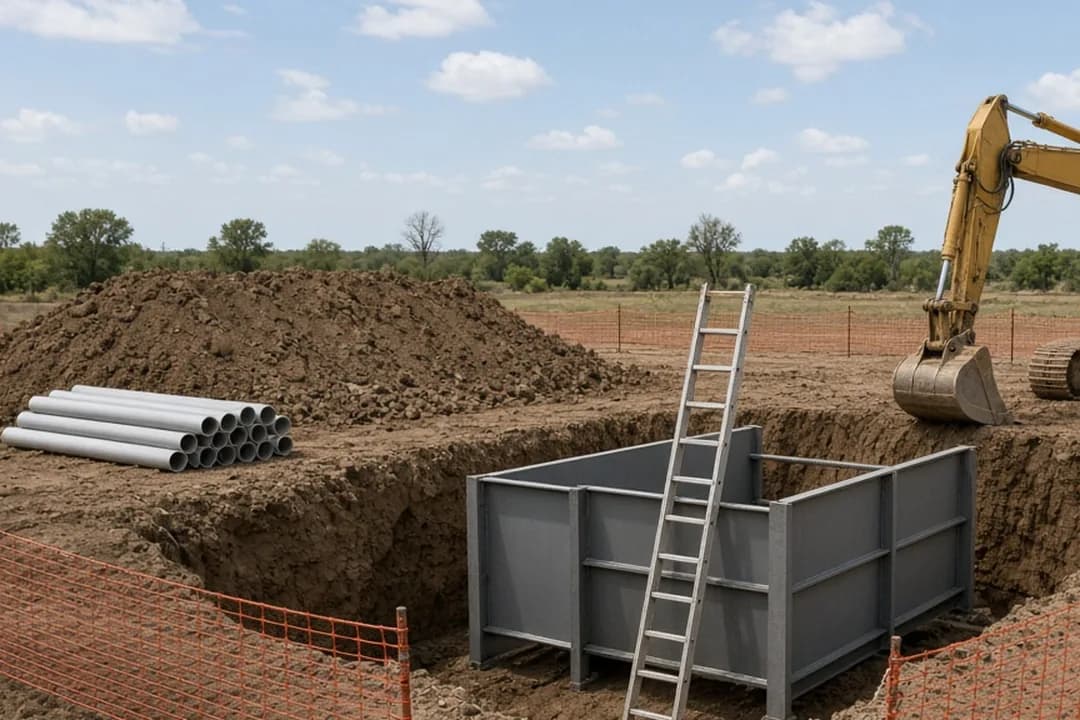
Shield systems, often called trench boxes, protect workers inside them rather than holding the trench walls in place. OSHA requires shields to be installed in a way that restricts lateral or other hazardous movement, and no one may be inside a shield while it is installed, removed or moved vertically. Excavating up to 2 feet below the bottom of a shield is permitted only if the shield is designed for the full depth and there's no sign of soil loss from behind or below it.
Support systems such as hydraulic or timber shoring hold the walls. They are installed and removed in ways that protect workers, removal starts at the bottom, and backfill follows closely. Design options include OSHA's appendices for timber and aluminum hydraulic shoring, manufacturer tabulated data, and engineer-designed systems.
Renting a box or shoring means sizing it to trench depth, width and pipe length, and making sure the excavator can lift and set it. Get the manufacturer's tabulated data with the rental and keep it on site.
Daily Rules: Locates, Spoil, Access and Inspections
- Locate utilities before opening the excavation, and find their exact location by safe means as digging approaches them. See utility locates before digging.
- Keep spoil, materials and equipment at least 2 feet from the edge, or use retaining devices.
- Provide a stairway, ladder, ramp or other safe exit in trenches 4 feet or deeper, within 25 feet of lateral travel for every worker.
- Keep workers out from under loads handled by lifting or digging equipment, and away from vehicles being loaded.
- Test the atmosphere in excavations deeper than 4 feet where oxygen deficiency or hazardous atmospheres could exist, such as near landfills or fuel storage.
- Don't work in accumulated water unless precautions are taken; water removal is monitored by a competent person.
- Have a competent person inspect excavations and protective systems daily before work, as needed during the shift, and after every rainstorm or other hazard-increasing event.
Local permits add backfill and site rules. Cedar Hill requires a temporary security fence around every right-of-way excavation at the end of each day, and Burleson doesn't permit street cuts in its right-of-way. Compaction equipment for backfill is covered in site preparation equipment.
Specifications are taken from manufacturers' published materials and can change. This guide is general information. Always follow the manufacturer's instructions, your rental provider's requirements and your jobsite's safety rules.