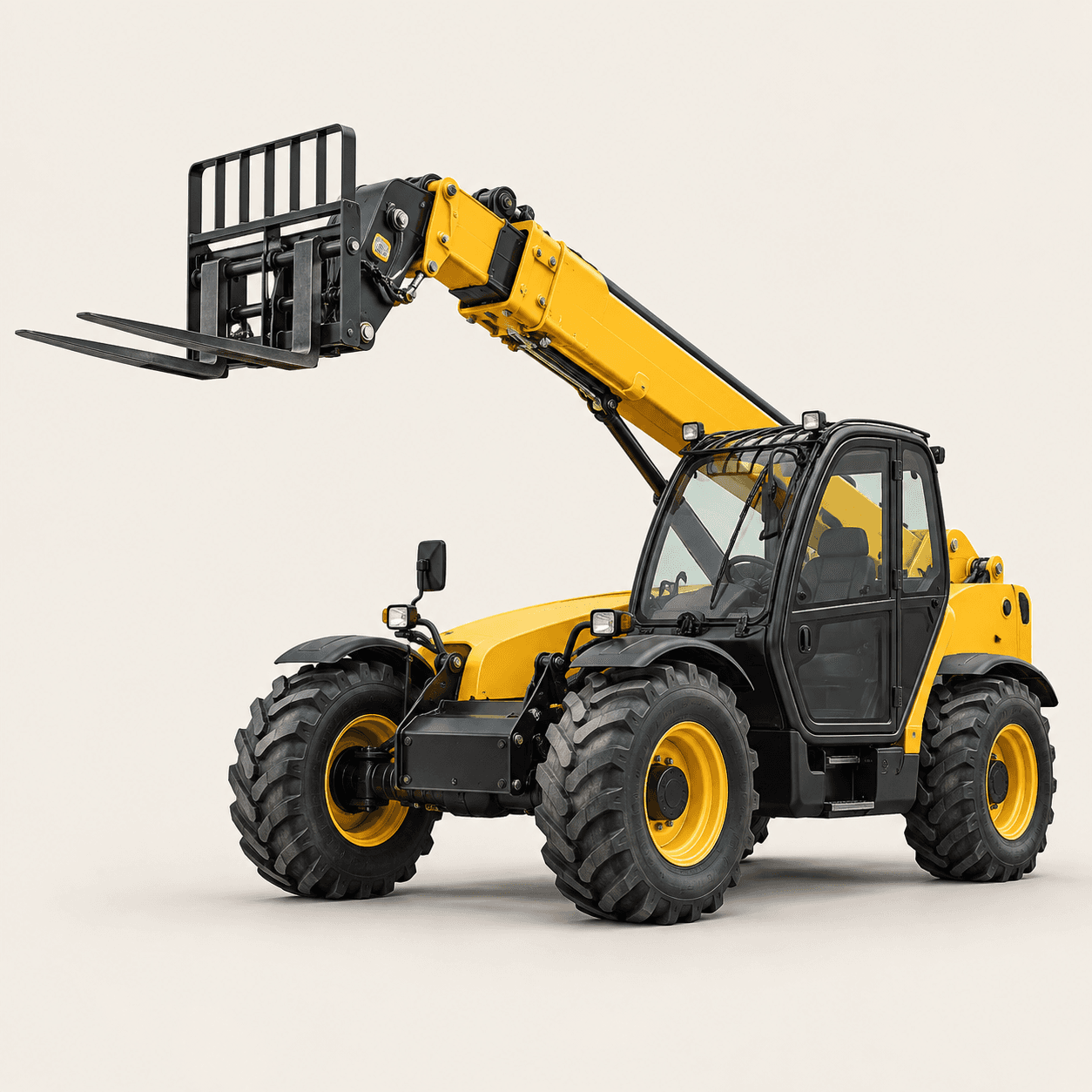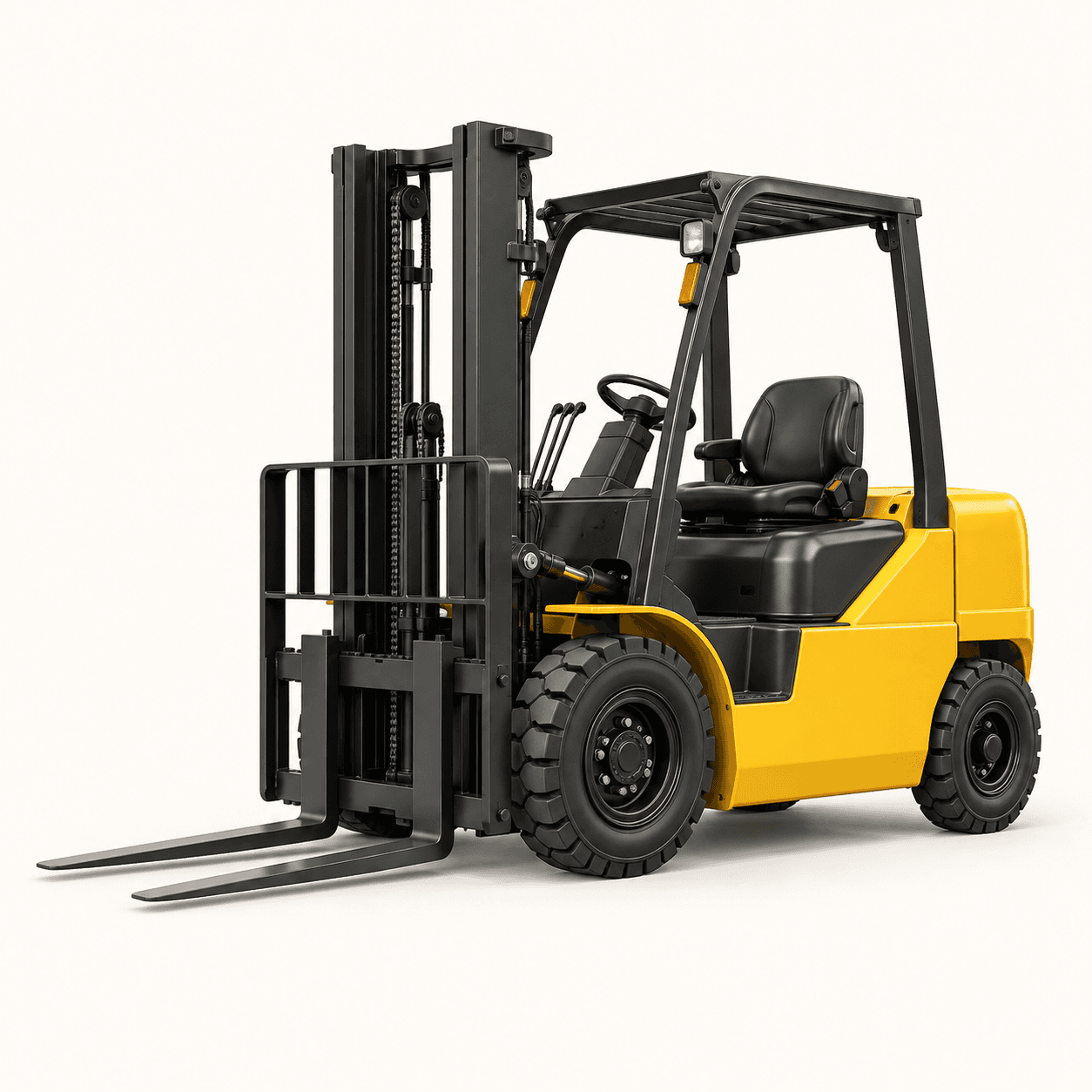
How the Two Machines Differ
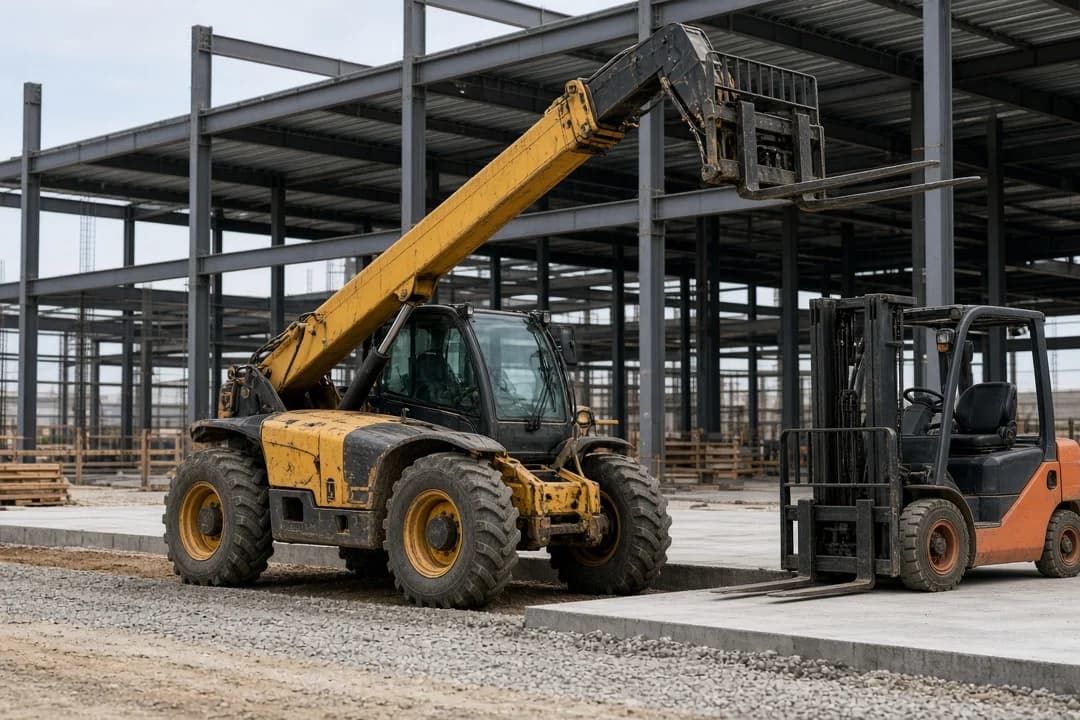
A forklift carries the load on forks attached to a vertical mast at the front of the machine, with a counterweight at the back. It lifts straight up and drives with the load low. Most of its stability comes from the counterweight and the machine's three-point stability triangle.
A telehandler, or telescopic handler, mounts the forks or another attachment on the end of a telescoping boom. The boom can lift and reach forward, which lets the operator place a load beyond the front wheels: over a fence, onto a second-story deck, or across a trench. Larger units use stabilizers or frame leveling to stay stable at full reach.
Best for: Forklift is best for
- Unloading trucks on paved lots and docks
- Moving pallets on finished slabs and in warehouses
- Tight indoor aisles where a boom would not fit
- Repeated short cycles at low lift heights
Best for: Telehandler is best for
- Placing loads on roofs, upper floors and scaffold landings
- Reaching over walls, trenches or landscaping
- Rough, sloped or unpaved construction ground
- Jobs that need buckets, jibs or other boom attachments
Start With Where the Load Has to Go
Sketch the delivery point before you call a provider. If the load only needs to come off a truck and move across a slab, a forklift usually does the job with less machine. If it has to land on a roof, a balcony, or the far side of a wall or excavation, you need forward reach, which a forklift's mast cannot provide.
- Height: the highest point a load must reach, plus clearance over parapets or guardrails.
- Forward reach: horizontal distance from where the machine can safely stand to where the load lands.
- Load: weight and dimensions of the heaviest pick, including pallets and packaging.
- Path: the route from the delivery truck to the set point, including gates, grades and overhead lines.
Multi-story mixed-use projects around the TEXRail station districts in North Richland Hills and in the form-based districts of Rowlett are typical telehandler jobs: materials have to go up, often over finished streetscape. Paved commercial and distribution sites in DeSoto and Euless are more often forklift territory once slabs and lots are in.
Load Charts and Load Centers
Every forklift must have its rated capacity clearly posted where the operator can see it, and that rating must not be exceeded. If the manufacturer offers removable counterweights, the alternate ratings must be shown too. Modifications that affect capacity need the manufacturer's written approval.
Forklift ratings are tied to a load center, the distance from the face of the forks to the load's center of gravity. OSHA's stability appendix explains that trucks rated at 30,000 pounds or less are normally rated at a 24-inch load center. A longer or off-center load moves its center of gravity forward and lowers the weight the truck can safely carry.
Telehandler capacity depends on boom angle and extension as well as load center, so the number in a brochure is only the starting point. Ask the provider for the load chart for the exact model and attachment, and check the pick at the reach you actually need.
| Question | Why it matters |
|---|---|
| What is the heaviest load, and how long is it? | Long loads push the center of gravity out and cut rated capacity. |
| How far forward and how high must it go? | Telehandler capacity drops as the boom extends; a forklift cannot reach forward at all. |
| Which attachment will be on the machine? | Attachments change the rating; non-factory attachments must be marked with the combined weight. |
| What surface will the machine work on? | Soft, sloped or rutted ground calls for a rough-terrain machine and ground prep. |
Ground, Slopes and Weather
Ground conditions decide many of these rentals. Industrial forklifts are built for firm, level floors. Rough-terrain forklifts and telehandlers have larger tires and more clearance for construction sites, but every machine needs a surface that can carry it with the load raised.
OSHA's truck rules require loaded trucks to travel with the load upgrade on grades over 10 percent, with the load tilted back and raised only enough to clear the surface. No one may stand or pass under an elevated load. Operators should slow down for wet and slippery surfaces.
North Texas clay complicates this. USDA describes Houston Black, the Blackland Prairie's signature soil, as very high in shrink-swell, and NWS Fort Worth notes spring and fall are the region's wettest seasons. After rain, an unpaved staging area that carried a telehandler last week may not carry it today. Plan gravel, mats or a paved setup point.
Attachments and Lifting People
Forks handle most work for both machines. Telehandlers commonly take a wider range of boom attachments, such as buckets, truss booms or jibs, which is part of why they show up on framing and roofing jobs. Ask which attachments are approved for the model, and whether the provider supplies the matching load charts.
OSHA requires trucks with front-end attachments other than factory installed ones to be marked with the attachment and the approximate weight of the combination at maximum elevation. When a truck is used to lift personnel, OSHA requires a safety platform firmly secured to the carriage or forks, a way for the people on the platform to shut off power, and protection from falling objects where conditions call for it.
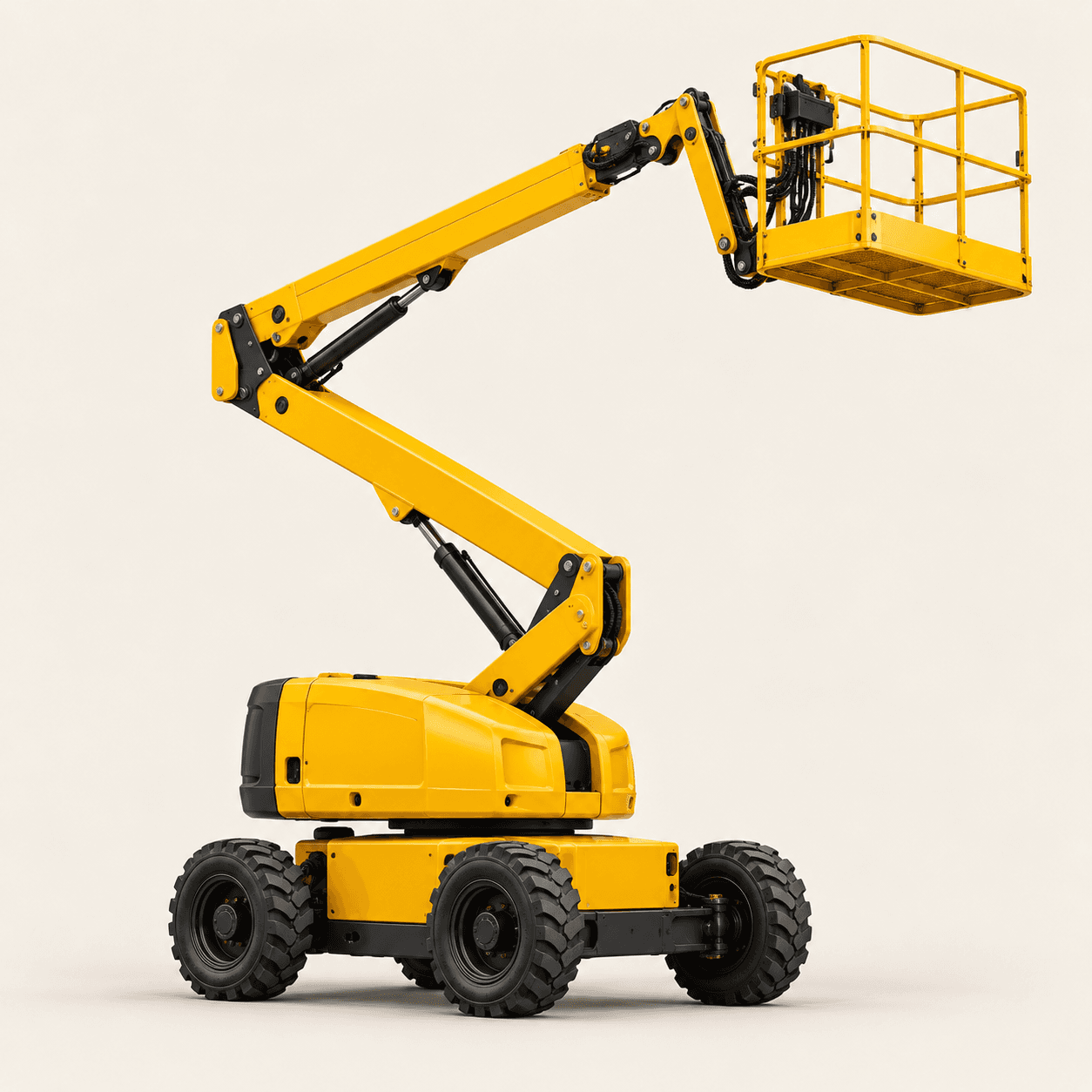
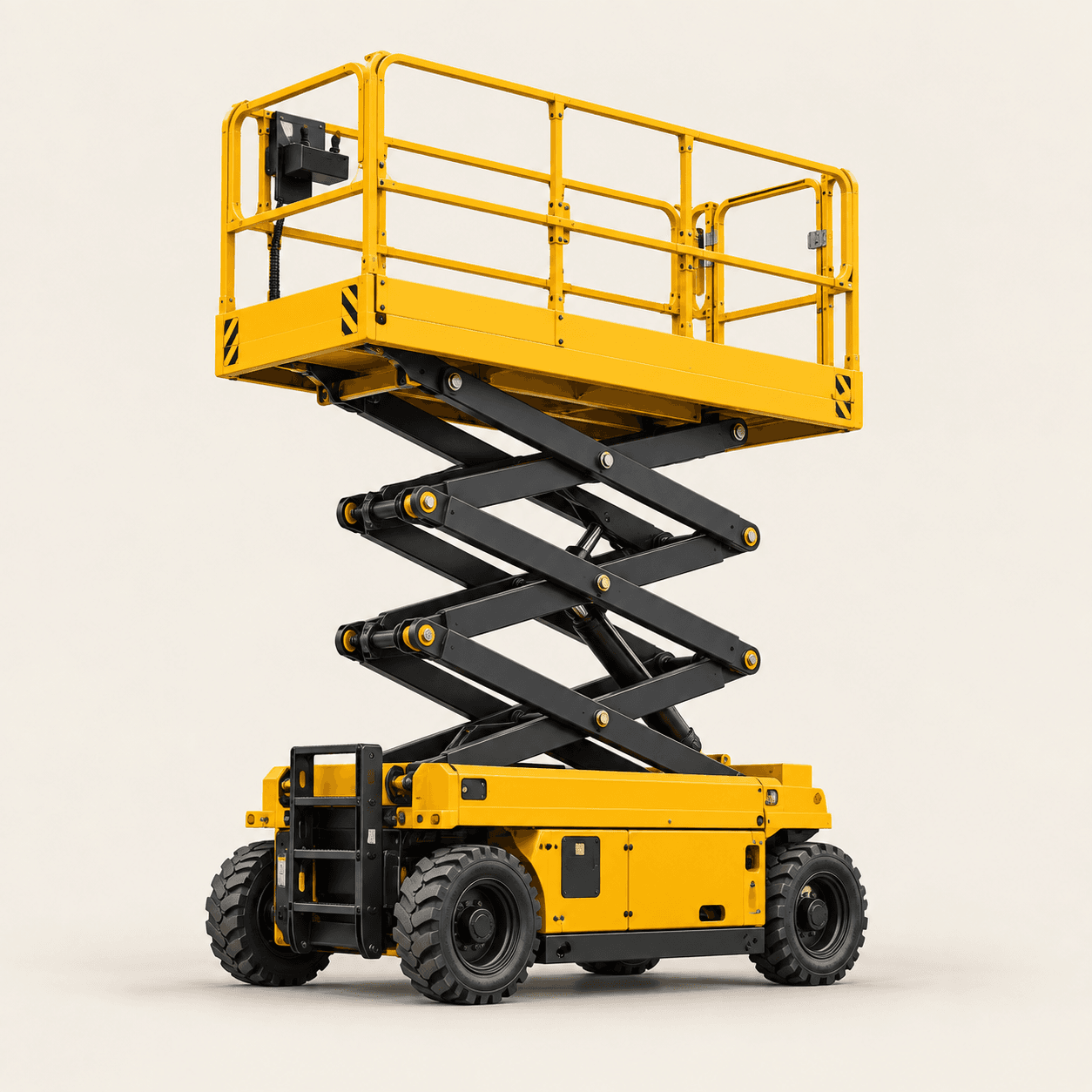
For regular work at height, an aerial lift is usually the better rental. See how to choose a boom lift.
Operator Training and Certification
OSHA's construction rule for powered industrial truck operator training (29 CFR 1926.602(d)) is identical to the general industry rule at 1910.178(l). Before anyone operates a truck outside of training, the employer must make sure they have completed training and an evaluation.
- Training combines formal instruction, practical exercises and an evaluation of the operator's performance in the workplace.
- Topics include the specific truck type, its capacity and stability, and workplace conditions such as surfaces, ramps, pedestrian traffic and ventilation.
- Refresher training is required after unsafe operation, an accident or near miss, a poor evaluation, a change of truck type, or a change in workplace conditions.
- Each operator's performance must be evaluated at least once every three years.
- The employer must certify each operator's training and evaluation with names and dates.
Ask the provider for the operator's manual and any machine-specific familiarization before the first lift, especially when moving operators from a forklift to a telehandler. A change of truck type is one of the triggers for refresher training.
Site Rules That Affect Material Handling
Local rules decide when deliveries and lifts can happen. Wylie prohibits deliveries outside its 7 a.m. to 9 p.m. Monday-through-Saturday construction hours. DeSoto bars heavy equipment on Sundays without written consent. North Richland Hills shifts its outdoor construction hours between standard and daylight saving time.
Near airports, tall booms can raise FAA notice questions. Euless sits on the southwest side of DFW Airport, where federal rules can require FAA notice for tall equipment, including temporary cranes, near runways. Overhead power lines matter on every site; Texas law restricts work near high-voltage lines.
Use the equipment rental checklist to confirm access, delivery windows and operators before the machine arrives.
Specifications are taken from manufacturers' published materials and can change. This guide is general information. Always follow the manufacturer's instructions, your rental provider's requirements and your jobsite's safety rules.