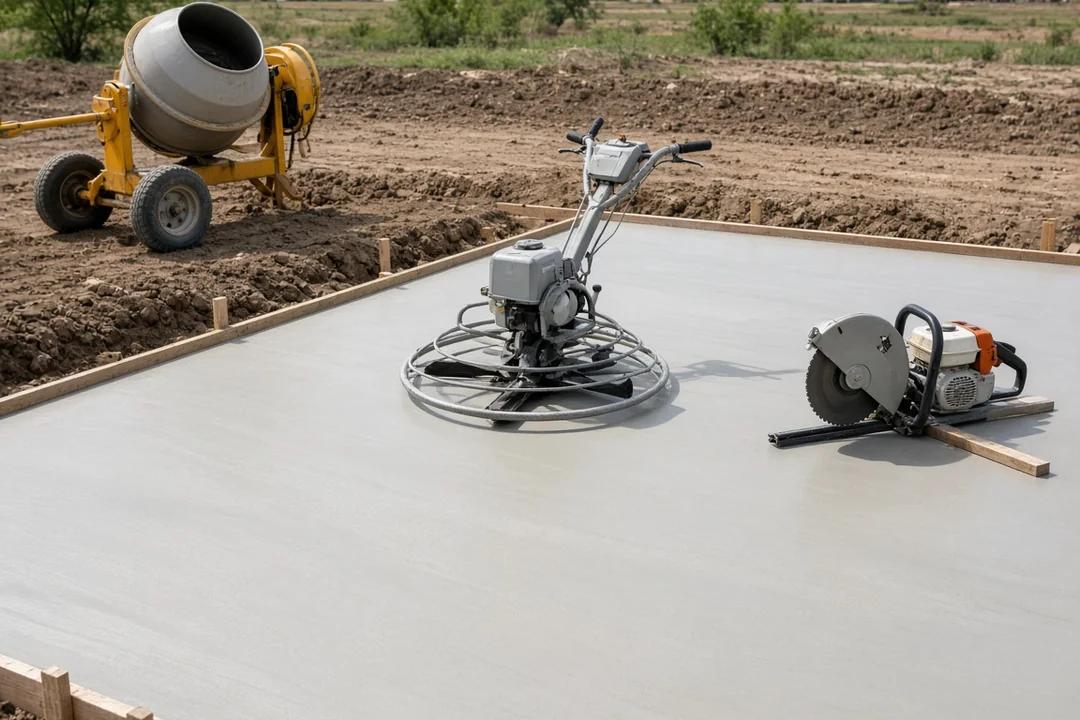
Three Jobs, Three Kinds of Equipment
Best for: Mixing
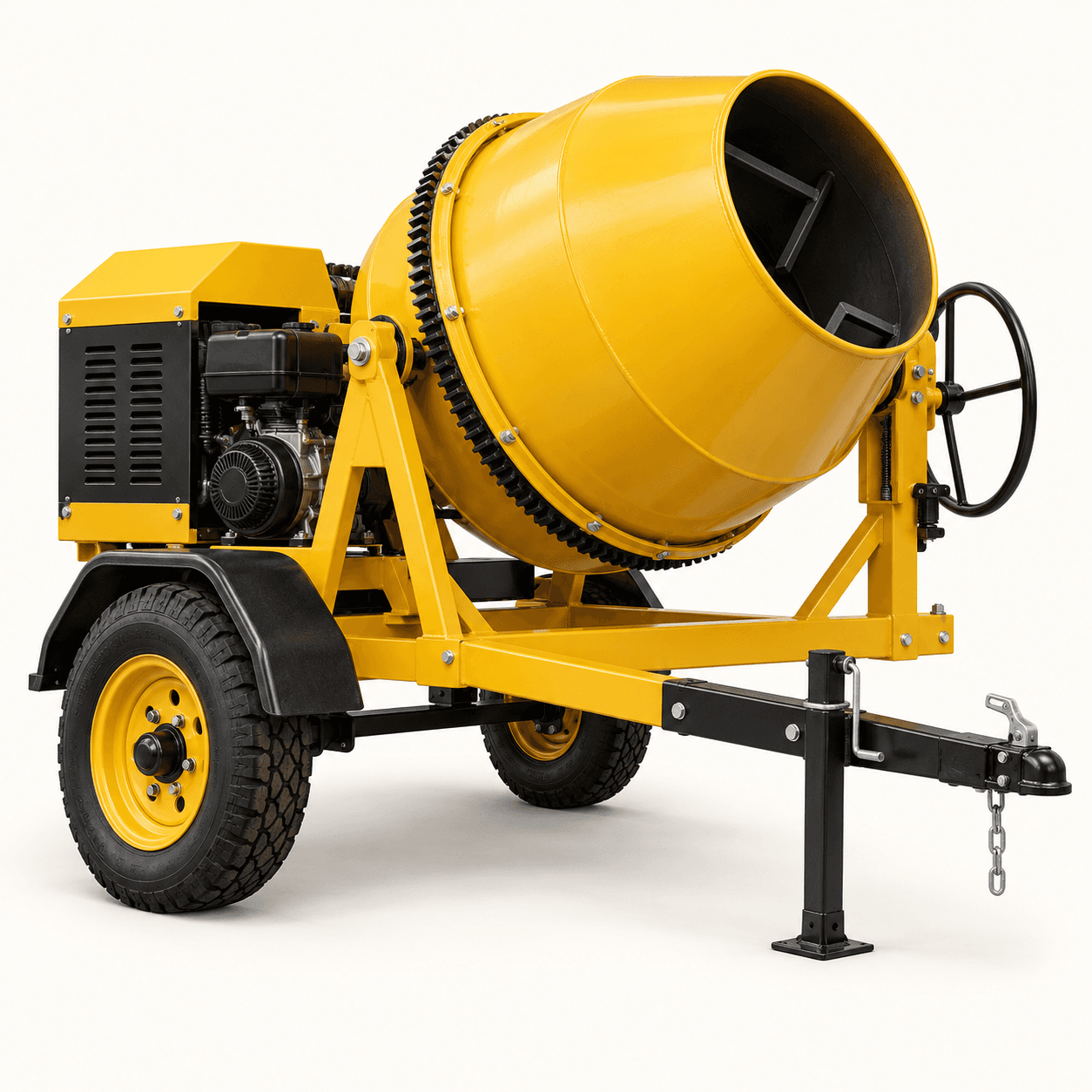
- Drum mixers for footings, posts and repairs
- Electric and gas models
- Towable units for moving between sites
- Ready-mix trucks for larger pours
Best for: Placing and finishing
- Buggies and chutes to move concrete
- Bull floats for early finishing
- Walk-behind power trowels on slabs
- Vibrators to consolidate in forms
Best for: Cutting
- Handheld power cutters for shallow cuts
- Walk-behind saws for longer, deeper cuts
- Joint cutting in new slabs
- Pavement cuts for utility work
Most rental concrete equipment orders mix all three. Plan the pour from the subgrade up: a slab that cracks over soft fill isn't an equipment problem, so pair this guide with choosing compaction equipment.
What Common Rental Units Do
| Example | Type | Key capacity | Other published specs |
|---|---|---|---|
| Multiquip MC94P series | Towable drum mixer | 9 cu ft drum (one bag) | Manual dump; 23 in discharge height; B78x13 tires; 106 × 51 × 72 in overall |
| Whiteman J36B65 | Walk-behind power trowel | 36 in ring, 4 blades | 60 to 115 RPM rotor speed; 184 lb operating weight |
| Husqvarna K 770 (14 in) | Handheld power cutter | 5 in maximum cutting depth | 14 in maximum blade; 5 hp; 22.4 lb |
| Husqvarna K 770 (12 in) | Handheld power cutter | 4 in maximum cutting depth | 12 in maximum blade; 5 hp; 22 lb |
Read the capacity before the brand. A 9 cu ft drum mixes about one bag at a time, so it fits post holes, steps and patch work, not a driveway. A 36-inch trowel finishes slabs that a crew can reach while the concrete is workable. A handheld cutter's 4 or 5 inches of depth covers many sidewalk and slab cuts, while thicker pavement needs a larger saw.
Mixing and Placing Safely
OSHA's concrete rules in Subpart Q apply to the tools around the pour. Mixers with loading skips of one cubic yard or more need a mechanical device to clear the skip and guardrails on each side of it. Concrete buggy handles can't extend beyond the wheels, and concrete buckets with hydraulic or pneumatic gates need positive safety latches to prevent accidental dumping.
- Guard protruding rebar that workers could fall onto, to eliminate the impalement hazard.
- Don't let anyone ride concrete buckets or work under them while they're raised or lowered.
- Bull float handles used where they could touch energized conductors must be nonconductive or insulated.
- Lock out and tag mixers and pumps before maintenance or repair.
Power Trowels and Finishing
Manually guided power trowels must have a control switch that shuts off power automatically when the operator's hands leave the handles. Test it before the slab is ready, not during finishing.
Whiteman lists the J36's rotor speed at 60 to 115 RPM and its operating weight at 184 lb. Ask the provider which blades or pans come with the trowel, since float and finish passes use different setups, and confirm fuel type for indoor work.
Cutting Concrete: Silica Rules
Cutting concrete makes respirable crystalline silica dust, and OSHA's construction silica standard applies. Following Table 1 for the tool is the simplest way to comply.
| Tool | Engineering control | Respirator, 4 hours or less per shift | Respirator, more than 4 hours per shift |
|---|---|---|---|
| Handheld power saw, outdoors | Integrated water delivery feeding the blade continuously | None | APF 10 |
| Handheld power saw, indoors or enclosed | Integrated water delivery feeding the blade continuously | APF 10 | APF 10 |
| Walk-behind saw, outdoors | Integrated water delivery feeding the blade continuously | None | None |
| Walk-behind saw, indoors or enclosed | Integrated water delivery feeding the blade continuously | APF 10 | APF 10 |
- Don't dry sweep or dry brush silica dust where wet sweeping or HEPA vacuuming is feasible.
- Don't use compressed air to clean clothing or surfaces unless it's paired with a ventilation system that captures the dust, or no alternative is feasible.
- Employers need a written exposure control plan for tasks that create silica exposure.
- Stationary masonry saws need a semicircular blade guard that retains blade fragments.
Street Cuts and Pavement Repairs
In the right-of-way, the city decides how pavement is cut and restored. Farmers Branch requires full-depth saw cuts, removal at least 3 feet wider than the trench, temporary repairs within two business days and permanent concrete within 14 working days that reaches 3,600 psi within 72 hours, plated until it does. Duncanville requires steel plates at least 1 inch thick that extend 1 foot past the trench. In Hurst, cutting streets, curbs, sidewalks or drive approaches needs a bond as well as a ROW permit.
A saw cut is still digging once the pavement comes out. Call 811 before excavating, and see utility locates before digging for City locate requirements.
Before You Rent
- Pour size and whether a drum mixer or ready-mix delivery fits it.
- Slab area and finish, and the trowel ring size and blades needed.
- Cut depth and length, indoors or outdoors, and the matching Table 1 controls.
- Water supply for wet cutting and a plan for slurry cleanup.
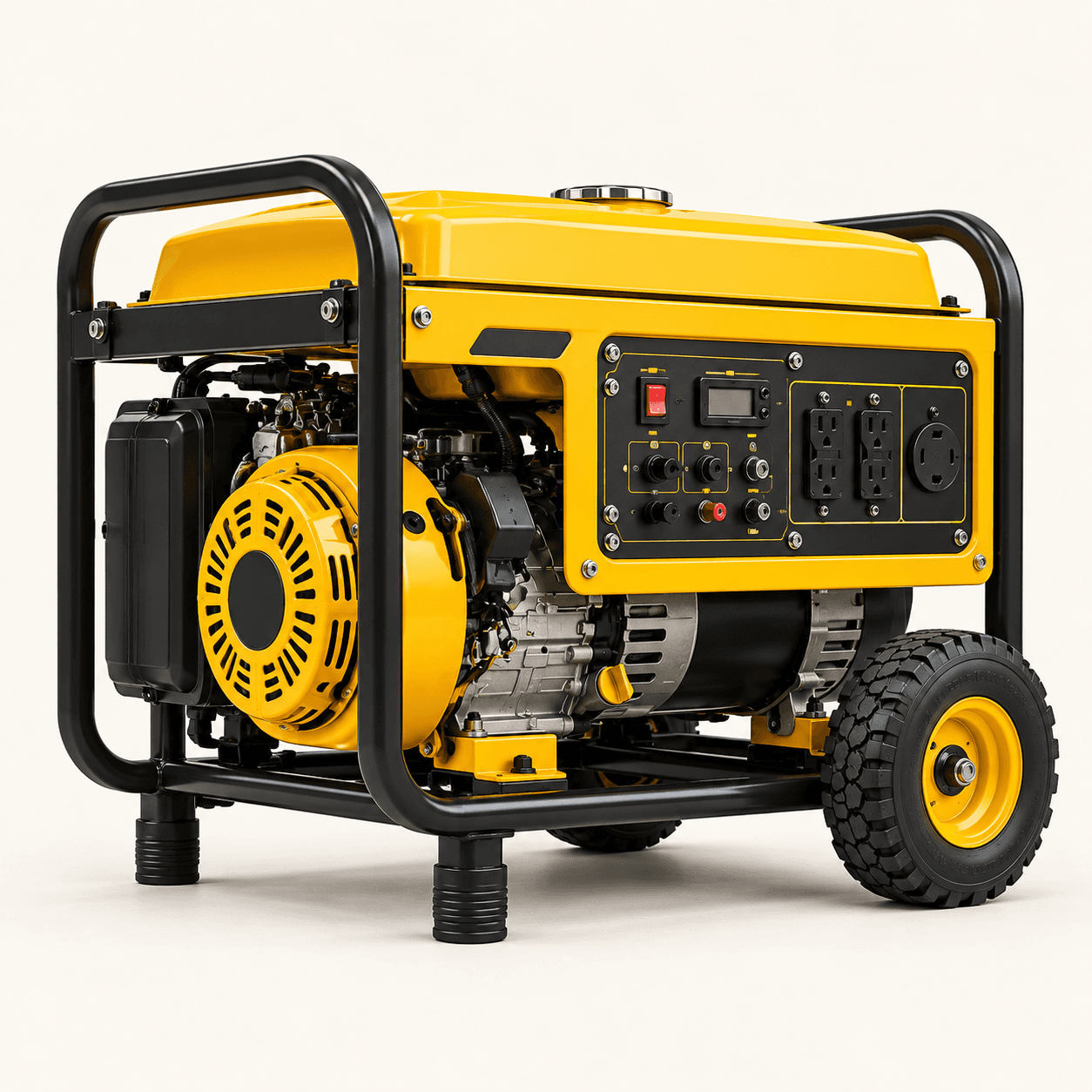
- Power: electric tools need a suitable source; see jobsite generator sizing.
- City ROW rules for street cuts, plates and restoration timing.
Specifications are taken from manufacturers' published materials and can change. This guide is general information. Always follow the manufacturer's instructions, your rental provider's requirements and your jobsite's safety rules.